Over the years, I have used a number of cameras. With the advent of digital photography, many of the old film cameras have basically become obsolete. I started collecting some of the old cameras. Some of these were used by me for years and others have been donated to the museum. More will be added as the collection grows. They are listed in order of age, with the oldest first.

1918 Seneca Folding Scout 2C. The
Seneca Camera company made the Folding Scout line from 1915
to 1925. This camera features a Wollensack Meniscus lens.
The bellows and lens fold up nicely inside the body with a
slide mechanism to make it compact. (Eric Van Gilder
collection-RLB)

1930-1942 Kodak Brownie Junior Six-16. Kodak made a lot of
different models of the Brownie over the years. These
originally sold for $2.75, and today are worth about $10-15.
(Eric Van Gilder collection-RLB)

1940-1952 Brownie Reflex Synchro Model. The design for this
twin-lens reflex camera was patented in 1940. They were
produced in the US form 1940-1952 and in the UK from 1946 to
1960. The original price for this camera was $5.25. (Eric
Van Gilder collection-RLB)

1948 Ansco Shur Shot 20. Originally manufactured under the
Agfa-Ansco name until 1943, this cameras basic design made
it reliable and dependable. These are still found at swap
meets and other places, still in working order. (Eric Van
Gilder collection-RLB)

1954 Argus C3. The C3 was mass produced between 1939 and
1966 as a low-price rangefinder. Dubbed "the Brick" because
of it's size, shape and width, it was a rugged and reliable
camera for a low-price. Their simple construction makes them
easy to repair and they are still popular amongst film
shooters today. It's been said that the C3 was what made
35mm film popular in the United States. Noted WWII soldier
and photographer Tony Vaccaro used the C3 throughout Europe
during WWII and after, often developing the film in his
helmet! (Eric Van Gilder collection-RLB)
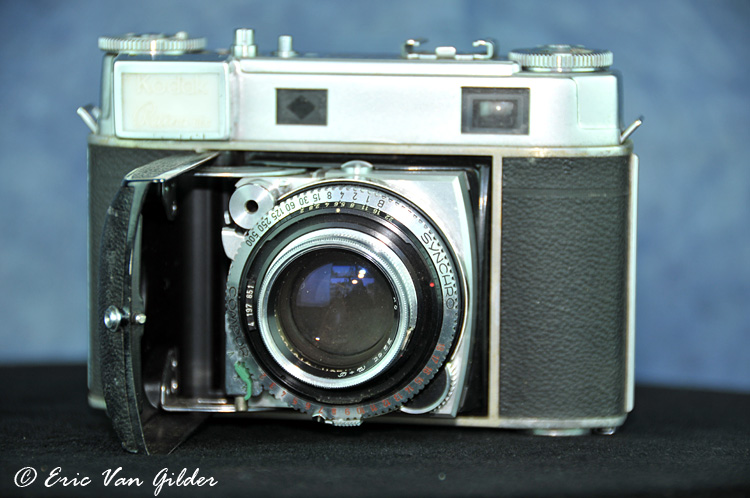
1954-1957 Kodak Retina III-c. One of the unique features of this camera was the door on the front that would swing away from the body of the camera so they lens could extend. This made the camera more compact. Because of their compact design, they were difficult to repair. (Donated by David Loue)

1956 Argus L3 light meter. There were four versions of the L3 light meter, manufactured by Metrawatt of Germany and is identical to the Metrawatt Horvex 2, but with a black case instead of white. (Eric Van Gilder Collection-RLB)

1958 Yashica 44. There were 3 different models of the
44 built, this was the first of the line. It was launched to
compete with the Franke and Heidecke Rolleifles "Baby
Rollei". Because of litigation issue for copying the Rollei,
and a high price for a limited set of functions compared to
cameras in it's class made this line short lived. It is
generally believed that this camera line production ended in
1964. (Eric Van Gilder collection-RLB)

1959 Argus C44R Rapidwind. The C44R replaced the C44 and
replaced the film winding knob with the winder style lever.
This design is basically an update to the C4 line, with lens
mounts that make removal and replacement of the lens easy
(when compared to a Rubik's cube). The styling of the camera
made it attractive to prospective buyers. It was the last of
the Argus Rangefinder line. (Eric Van Gilder collection-RLB)

1960s vintage Kalimar light meter. The meter was manufactured in Japan by another company. This light meter could clip on to the flash shoe to provide a photographer with a "built in" light meter. As with other collectors, this one had the battery still in it that leaked and is no longer available.
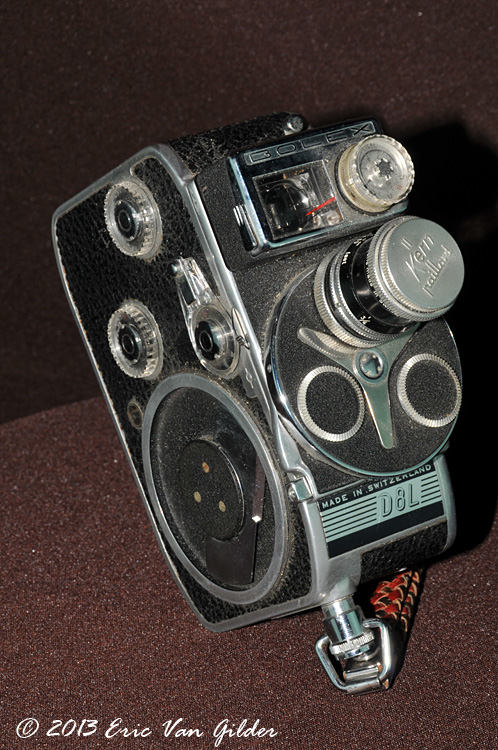
1962 Bolex D-8LA 8mm movie camera. The D-8LA camera was an upgrade to the D-8L that offered improvements in the metering and for certain lenses. The three-lens turret allowed you to change lenses easily while taking movies. It was described as a "pocket camera", but at 5" x 3.5" x 2" and weighing in a 28 oz. (over a pound and a half without film), I can't imagine the size pocket one would need. Plus you'd need a good belt to hold up your pants!

1972 Yashica TL Electro with the Yashica 50mm lens. The TL Electro line was introduced in 1968. The design and function are like most of the later 35mm SLR cameras. It features an LED light meter and all mechanical shutter assembly. My father used this camera for many years before going to digital. Aside from some dust and dirt, the camera is still in perfect working order. The mechanical self timer works like a champ too. It has a good solid feel to it. (Eric Van Gilder collection-RLB)

JC Penney branded 135mm lens for the Yashica TL Electro. I have heard that thi slens was made by a number of different manufacturers for JC Penney's. I am trying to get confirmation, as I have heard Pentax, Cosina, Vivitar and others. (Eric Van Gilder collection-RLB)

1981 Polaroid Sun 660 AF. The Sun 660 was part of the 600 series line from polaroid introduced in 1981. The lens in a single element 116mm at f/11 with a minimum focus distance of 3 feet. The large gold screen on the left side of the camera was one of the uniques features. It calculated distance to the subject using sonar to autofocus the lens. The slide switch under the lens allowed the shooter to adjust the exposure with a lighten/darken adjustment. Before the days of digital photography, the Polaroids were the original cameras to give you the instant gratification of seeing what you photographed almost right away. (Donated by Molly Harris)

1980-1982 Kodak Tele-Ektra 300. The Tele-Ektra 300 sold from 1980-1981 with a list price of $32.50. With a slide with to adjust between 22mm and 44mm, this was a fun little 110 camera that got some heavy use when I was a teenager. It survived me falling and sliding down a mountain side in Estes Park Colorado while in my back pocket. It was a great snapshot quality camera that was capable of surviving a ton of abuse. (Eric Van Gilder collection)

1983 Minolta X-370 with 50mm lens. This camera was a workhorse. It went all over the world with me in the 1980s. It finally quit on me in the desert at Ocotillo Wells California. A friend fixed it for me and it still works today, but I stopped shooting film many years ago. I still have the original receipt for the purchase of the camera body with a 28mm lens in 1985. I bought it at the AAFES Base Echange at Keesler AFB, Mississippi. It cost me two weeks pay in those days. From beaches, to islands, to deserts and everything in between, this camera has taken photos in places I will likely never see again. I have boxes and albums full of photos taken with this camera. (Eric Van Gilder collection)

1980s Albinar ADG 80-200mm f/3.9 for a Minolta X series camera. This was my first "big" airshow lens. I got it as a gift in about 1985-1986 from my parents. I don't know what they cost initially, but they weren't cheap. Sadly, today they sell for about $25 on e-bay. After years of abuse and traveling all over the world, it sits in a display case now. (Eric Van Gilder collection)

1988 Canon RC-250 Xap Shot. This was my father's first foray into digital photography. It was $499 for the camera by itself. You could playback the images on a TV. There was an additional kit for $999 that had a floppy disk, battery, computer interface card and software. It was also usable with the Mac using ComputerEyes software. It was not truly a photo camera, but more of a still video camera. (Eric Van Gilder collection-RLB)

1990s Snapsights underwater camera. The Snapsights underwater camera was a point and shoot camera with an underwater housing that was shockproof and waterproof up to 75 feet. It had a fixed 28mm lens. It was designed to be inexpensive to save your more expensive camera gear from being damaged during activity that is not normally conducive to photography. (Donated by Molly Harris)

Canon Sureshot 105 Zoom. This was a film point and shoot camera that was quite popular. It was introduced in 1997 and featured a three-point autofocus and film autoloading. These were very successful cameras for Canon and became the predecessors to the Canon PowerShot digital point and shoot line. With a zoom of 38-105mm, it was a pretty good range for the time. (Donated by Molly Harris)

1997 Sony Mavica MVC-FD7. Mavica was an acronym for MAgnetic VIdeo CAmera. It was an electronic still video camera, essentially. The first Mavica was introduced in August 1981 with a CCD sensor that produced an image with a resolution of 570 x 490 pixels. That's a 279k image, or about 1/4 of a megapixel! This was the second model to come out with the 3.5" floppy drive and the first one to offer optical zoom (10x). (Eric Van Gilder collection-RLB)

1998 Sony Mavica FD-71. This is a MVC-FD-71 that was introduced in in mid-1998 that featured a 10x optical zoom. It wrote the image data to a 3.5" floppy disk. The maximum resolution on this was 1024x768, or about 3/4 of megapixel. Sony eventually produced 18 different models of the Mavica that used 3.5" floppy disks for storage. (Donated by Molly Harris)

1998 Sony Mavica MVC-FD-81. This was my first "digital" camera. Carrying this camera and a box of floppies seems ridiculous today, but it was not so bad then. This model was also introduced in 1998 and we used it for a few years before replacing it with the Canon PowerShot S50. (Eric Van Gilder collection)

1999 Sony Mavica MVC-FD-91. This model was introduced in 1999 and featured a 14x optical zoom. It also wrote the files to a floppy disk. It should also be noted that the Mavicas were also capable of shooting NTSC video. Writing that to a floppy was probably similar to the short amount of video you could get on an old 8mm movie camera. (Donated by Molly Harris)

1999 Olympus Newpic Zoom 60. Introduced in 1999, the Newpic Zoom 60featured auto-flash and red-eye reduction. With zoom range of 30-60mm, it was a nice little compact point and shoot film camera. I believe this was my last film camera that my wife and I had before going full digital. This one survived many rugged trips through the Sierra mountains in California. (Eric Van Gilder collection)

2003 Canon PowerShot S50. Canon introduced the PowerShot line of cameras in 1996. It became on of the best selling digital cameras in the world. This was our first serious purchase into digital photography. The lens glass was great although the range wasn't sufficient for my needs. At 5 Megapixels, the photos were clean and capable of enlargement. I took a photo of a taxiing T-6 years ago that is a 16x20" print now that hangs in my son's room. It survived many a tumble from my shirt pocket while hooking up tow-bars to aircraft and kept working. (Eric Van Gilder collection)

2006 Fisher-Price J8209 children's digital camera. This tough little camera was one that we gave our son many years ago. With a resolution of 640 x 480, it wasn't the best quality, but gave him the opportunity to play around with photography on a camera that was tough enough to get knocked around and dropped. (Eric Van Gilder collection)