The museum has an
unusual selection of rare and unique aircraft. Some of these
are one of a kind aircraft, while others are rare. Here are
some of them.
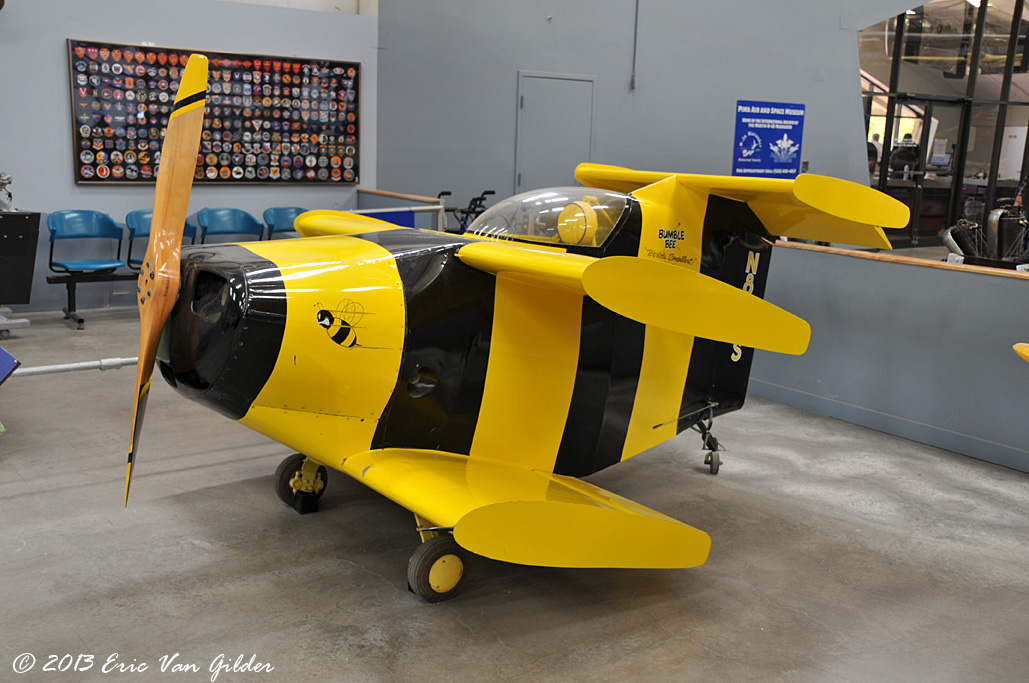
Starr Bumble Bee, the worlds smallest biplane to ever fly. It first flew on January 28, 1984 to become the smallest aircraft to ever fly. The record was later beaten by Roberts Starr's former partners in a monoplane. A smaller aircraft, the Bumble Bee II set another record in 1988 that was destroyed in a crash not long after setting the record.

McCullough HUM-1. It was designed as a 2 seat utility helicopter. Three prototypes were built for the Army and 2 were built for the Navy. Neither service has a use for them. The civil market was also indifferent to the MC-4 (civilian version) and the design was scrapped.

Lockheed D-21B Reconnaissance Drone. Little is known about this drone. It first flew in the mid 1960s, flown from an SR-71 and later a B-52. Several missions were flown before the program was scrapped in 1971.

Lockheed SR-71A Blackbird. The aircraft's unique shape make it easily recognizable. The Blackbird holds many speed and altitiude records, including a flight from Los Angeles to Washington DC in 1 hour, four minutes and 2 seconds. Made of mostly titanium, it was a technological leap when it was introduced and is still considered advanced. The top speed of the blackbird remains classified.

Columbia XJL-1. It was designed to replace the Grumman J2F Duck, but did not meet expectations and suffered from a number of structural failures. Of the three that were made, this is the only survivor.

North American F-107A. It was designed to meet the requirement for a USAF all-weather fighter bomber. It lost out to the Republic F-105. Two of the F-107 prototypes were sent to NASA after testing for control system experiments for the X-15 and for high speed research flights.

Front view of the North American F-107A

Douglas B-18B Bolo from the 25th Antisubmarine Wing, 4th Antisubmarine Squadron at Langley AFB, Virginia. The B-18 was based on the DC-2 airliner using similar wing, tail and engines. They were obsolete when WWII began, so they were outfitted with RADAR and magnetic anomaly detection gear to locate submarines in the Caribbean and Atlantic through 1943.

Lockheed YO-3A Quiet Star used by the FBI. They were first used in Vietnam to track troop movements of the North Vietnamese. Because of it's design, it is not heard from the ground when it is flying at 1,000 feet. After Vietnam, the YO-3s were used by NASA for noise studies, Louisiana department of Fish and Wildlife to track poachers and by the FBI.

Sikorsky S-43 Baby Clipper of VMJ-2 in San Diego. The military version of this aircraft was designated the JRS-1. They were designed as smaller airliners and military transport vehicles. Fifty three were built, and only three survive today.

Beech 2000A Starship. It was one of the most technologically advanced aircraft of its type. Burt Rutan designed this aircraft in 1982. Despite it's advances, it was a commercial failure. Of the 53 built only 2 or 3 are still being flown.

Sud Aviation SE-210 Caravelle. The Caravelle was the first jetliner produced by a European company other than the UK. The aircraft was the first to mount the engines on the rear fuselage. It was introduced into airline service in 1959 and the last flying Caravelle was retired in 2004.

Hawker-Siddeley FRG.1/XV-6A Kestrel. Joint testing with pilots from the US, UK and West Germany in 1965 on this aircraft showed promised for a VTOL aircraft. The US bought six aircraft after the testing at RAF West Raynham. Ironically, the US Military said it had no use for such an aircraft. A few years later, the USMC began flying the AV-8 Harrier, a descendant of the Kestrel.

Hawker-Siddeley FRG.1/XV-6A Kestrel. Closer examination of what I thought was a Harrier revealed USAF markings. The USAF never flew Harriers, so I knew this one was something different.

Hawker-Siddeley FRG.1/XV-6A Kestrel. Another angle of the Kestrel, which is currently under restoration.

Beech AT-11 Kansan in WWII USAAF colors. The AT-11 was used to train bombardiers and aerial gunners. A Beech 18 was altered with a plexiglass nose and Norden bombsight. A bomb bay was also added to carry 1000 pounds of bombs. Guns were added to the nose and top of the aircraft for gunnery training.

Culver PQ-14B Cadet. These aircraft were built from wood and designed to be manned or flown by remote control to train aerial gunners.

Ruhrstahl SD-1400 Fritz-X. The Fritz-X was a German anti-shipping bomb that could be guided from it's drop aircraft by radio control.

Nakajima Ki-43-IIB Hayabusa (Oscar) of the IJAF 63rd Sentai based in New Guinea. The Oscar entered service in 1941and were armed with just two machine guns in the nose throughout the war.

Boeing YC-14. The YC-14 was designed to replace the C-130. It competed against the McDonnell-Douglas YC-15. In the end, the USAF bought the improved version of the C-130. This is one of only two built.

Another view of the Boeing YC-14.

Northrop YC-125A Raider. The C-125 was designed to be used for tactical transport on unimproved fields. The Raider was the last tri-engined aircraft built for the US Military. When they entered production their primary jobs were being taken by helicopters. Twenty-three were built, most of them going to Latin America. Today, only 2 survive, both in museums in the US.

Boeing NB-52A Stratofortress from the USAF Flight Test Center at Edwards AFB. This is a rare aircraft as it was one of only 3 A models built, and this one was used to drop the X-15 for testing.